
What to Pack in a Family Emergency Kit: The Complete Guide
Last Updated: November 12, 2026
Quick Summary
Pack your family emergency kit with one gallon of water per person per day for at least three days, no-cook food you can eat straight from the package, a manual can opener, a stocked first aid kit, and a week of prescription medications in labeled bottles. Add battery-powered light, a power bank, a written family communication plan, sanitation supplies, and document copies in a waterproof container.
- Store one gallon of water per person per day for at least three days, and rotate stored water every six months.
- Pack food you can eat cold with no cooking and no tools, and rotate your food stash annually.
- Prescription medications are the item most often forgotten and the hardest to replace during a disaster.
- Give each child a small backpack with a flashlight, snack, water bottle, comfort item, and contact card.
- Build in phases over six months, starting with water, food, and a manual can opener in month one.
Table of Contents
- Start With Water, Food, and the Basics That Keep You Going
- First Aid Supplies and Medications Your Family Emergency Kit Needs
- Lighting, Power, and Communication Tools That Work When the Grid Doesn't
- Sanitation, Hygiene, and the Unsexy Stuff Nobody Talks About
- Emergency Preparedness for Kids: What to Pack and How to Involve Them
- Documents, Cash, and the Paper Trail You Can't Recreate
- Your 14-Day Emergency Kit List for Longer Shelter-In-Place Situations
- Comfort Items, Climate Tweaks, and Digital Preparedness: The Angles Most Checklists Skip
- Building Your Kit in Phases Without Blowing Your Budget
- Get Your Family Emergency Kit Ready to Grab and Go
- Frequently Asked Questions
Start With Water, Food, and the Basics That Keep You Going
Water is the first thing to pack in a family emergency kit, and the math is simple: store one gallon per person per day for at least three days. Dehydration is one of the fastest ways a bad day becomes a dangerous one. Below, we'll show you exactly how to size your water supply, what food actually earns its space, and where most beginner kits quietly fail. But first, here's what most guides get wrong: they hand you a list with no quantities, no rotation schedule, and no explanation of what you're prepping for.
Water: How Much and How to Store It
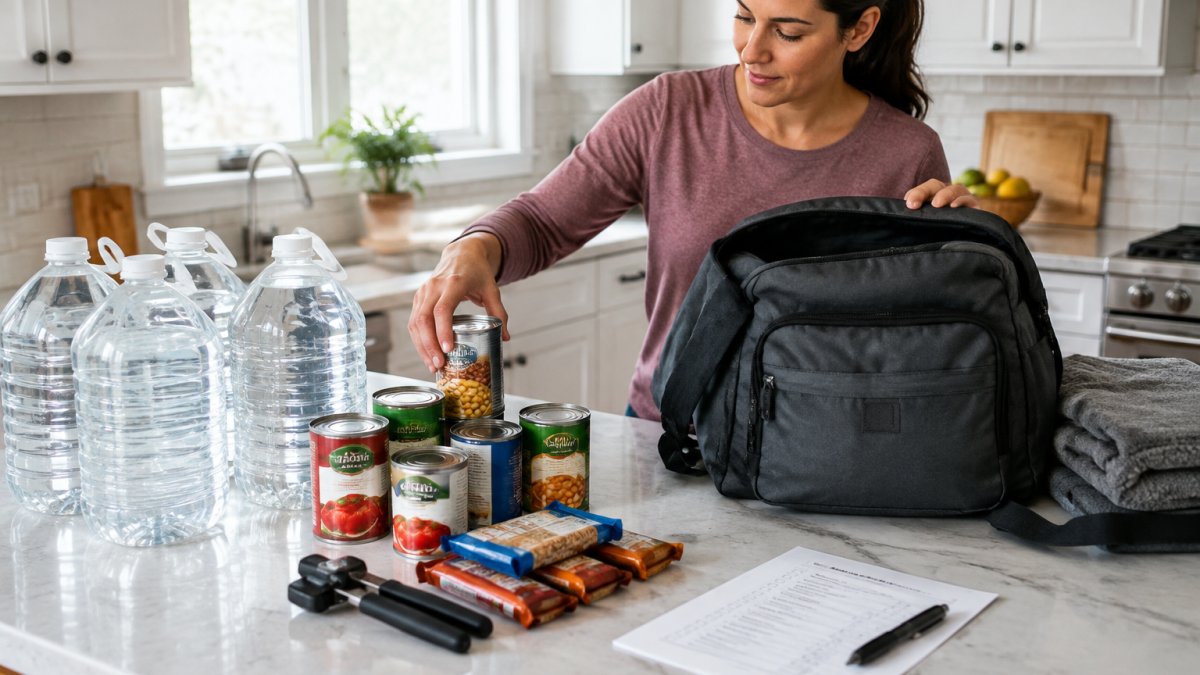
A three-day supply is the minimum for evacuation scenarios; two weeks is the target for shelter-in-place. The FEMA guidance on emergency water supply recommends one gallon per person per day for drinking and sanitation, and that figure climbs in heat or for pregnant and nursing family members.
Storage matters as much as quantity. A common mistake is buying heavy barrels you physically cannot move during an evacuation. Smaller containers you can actually carry are easier to move in an evacuation, such as a 5L emergency water storage jug that fits in a go-bag.
Food That Doesn't Need a Stove or a Can Opener
Pack food you can eat cold, straight from the package, with no cooking and no tools. That means protein bars, dehydrated food pouches that reconstitute in cold water, crackers, nut butter, and shelf-stable meals your kids will actually eat.
Watch out: rotate your food stash annually and skip anything your family has never tasted. An emergency is a terrible time to discover your seven-year-old refuses lentil stew.
First Aid Supplies and Medications Your Family Emergency Kit Needs
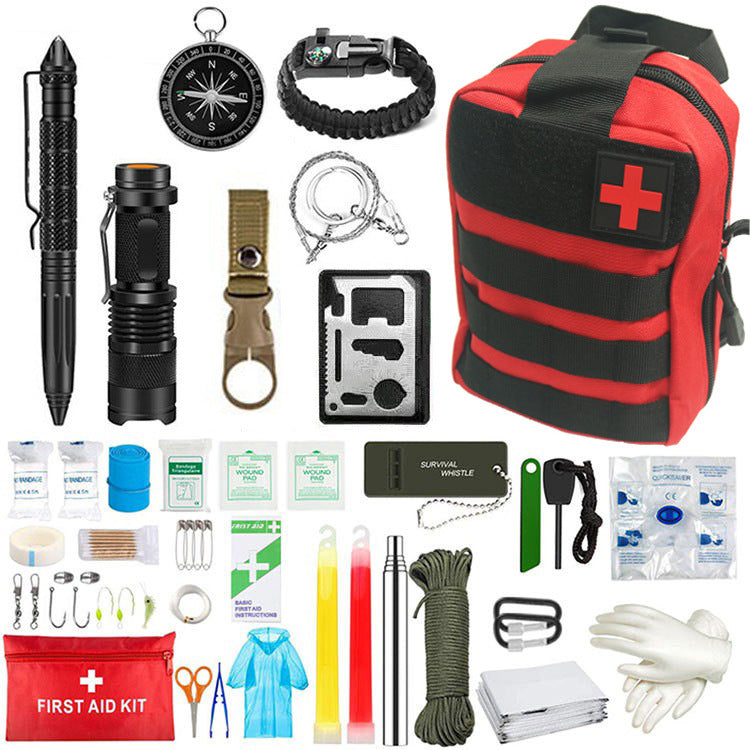
A family emergency kit needs a first aid kit stocked for real injuries, not just bandages, plus a full supply of every prescription medication your household takes. The survival first aid and emergency kit bundles bandages, gauze, antiseptic wipes, and tweezers alongside a compass, whistle, fire starter, and emergency blanket in one compact kit.
Add to it: a week of prescription medications in original labeled bottles, a list of dosages, spare glasses, and any inhalers or EpiPens your family relies on. Prescription medications are the item most often forgotten and the hardest to replace during a disaster, when pharmacies close and roads are blocked.
Lighting, Power, and Communication Tools That Work When the Grid Doesn't
Light and power tools belong in every kit because the grid is the first thing to go. Pack battery-powered or rechargeable light sources you can use hands-free, like a rechargeable LED headlamp with a wide beam and an SOS strobe mode.
Communication deserves its own line item: a family communication plan written on paper, an out-of-state contact everyone knows to call, and a whistle on every family member's keyring. For a deeper room-by-room breakdown, see our essential items for power outages checklist.
Sanitation, Hygiene, and the Unsexy Stuff Nobody Talks About
Sanitation supplies are the section every beginner skips, and the one that keeps your family healthy when plumbing fails. Pack moist towelettes, hand sanitizer, garbage bags, toilet paper, and a bucket with a lid for emergency toileting.
Duct tape and plastic sheeting earn a spot too, for sealing a room during a shelter-in-place order or patching a broken window. A multi-tool and a wrench or pliers let you shut off utilities.
Emergency Preparedness for Kids: What to Pack and How to Involve Them
Emergency preparedness for kids works best when children help build the kit rather than discover it in a crisis.
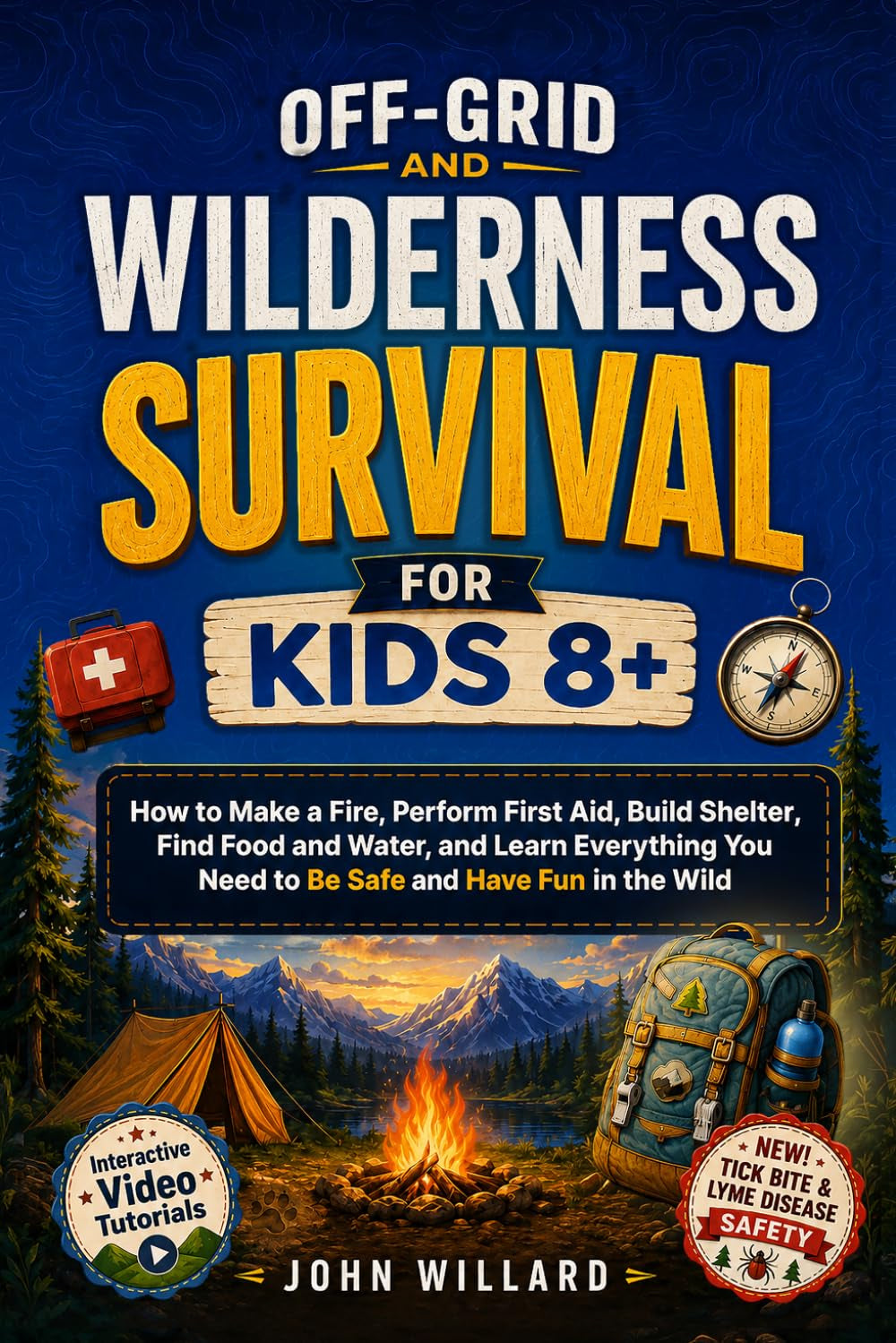
A kid who has practiced is a kid who stays calm. If you want a structured way to teach skills, a kid-focused survival skills guide walks through fire-building, first aid, shelter, and finding water at a level children can absorb. Keep the tone matter-of-fact.
Documents, Cash, and the Paper Trail You Can't Recreate
Documents and cash are the two categories people assume are already handled, and they almost never are. Store copies of IDs, birth certificates, insurance policies, medical records, and a household contact list in a waterproof container inside your kit. Digital copies in encrypted cloud storage help, but a power outage means no cloud, so keep paper.
Pack cash in small denominations. Card readers fail when networks go down, and small bills let you buy what you need without waiting for change. Add local maps printed on paper, since phone batteries die and GPS needs a signal you may not have.
Your 14-Day Emergency Kit List for Longer Shelter-In-Place Situations
A 14-day emergency kit list extends the three-day basics into a two-week supply for when roads close and stores stay shut. The three-day kit is built for evacuation; the fourteen-day kit is built for staying put, which changes both the quantities and the storage problem. Fourteen gallons of water per person is roughly 112 pounds, and fourteen days of food for a family of four fills a closet.
How the Quantities Scale
| Category | 3-Day Kit | 14-Day Kit | Rotation |
|---|---|---|---|
| Water | 1 gal/person/day | 14 gal/person | Every 6 months |
| Food | 3 days of no-cook meals | 14 days, mix of no-cook and heatable | Annually |
| Medications | 3-7 days | 14 days | Per expiry date |
| Sanitation | Basic hygiene pack | Extra bags, wipes, bucket liner | Check annually |
| Power | One power bank | Two banks plus radio | Charge quarterly |
| Fuel | None | Camp stove fuel or canned heat | Check seasonally |
Water Storage That Fits a Real Home
Fourteen gallons per person is the target, and splitting the supply into smaller containers can make it easier to manage. A few 5L jugs can be carried more easily than a single large barrel.
Watch out: water stored in translucent jugs near a window can grow algae and pick up a plastic taste; opaque containers or a dark closet solve both problems.
Food That Scales Without a Stove
Fourteen days of no-cook food gets monotonous fast, so build the two-week layer as a mix: about ten days of ready-to-eat items (protein bars, nut butter, crackers, canned fish, dried fruit) and four days of heatable meals (rice, pasta, oatmeal, canned soup) that require a camp stove or canned heat. Keep a manual can opener and a separate utensil kit. Rotate the whole stash annually by eating from it, which is also the only honest way to learn what your family will actually tolerate on day nine.
Watch out: canned heat and camp stove fuel produce carbon monoxide; never use them indoors without ventilation, and store the fuel away from the food.
Heating, Cooking, and the Fuel Most Lists Forget
A two-week shelter-in-place kit needs a way to boil water and warm food. A small camp stove with sealed fuel canisters is the common choice; canned heat is the low-cost backup. Store fuel according to the label, away from heat sources and out of reach of children, and check it seasonally. If you live in an apartment where open flame is not allowed, plan for a thermos-and-canned-heat approach instead and note it on your kit inventory.
Sanitation at Two-Week Scale
Two weeks of sanitation means more than a hygiene pack. Add extra garbage bags, a bucket with a lid and liner for emergency toileting, extra toilet paper, and a way to manage waste if collection stops. A common pattern is one bucket per household plus a supply of liner bags and a small shovel for burying waste if plumbing fails entirely.
Space, Rotation, and the Inventory Card
The practical failure point of a 14-day kit is not buying it, it is storing and rotating it. Designate one closet or shelving unit, keep a written inventory card taped to the door, and note the purchase or rotation date on every category. Rotate water every six months, food annually, medications per expiry, and power banks quarterly. Build the three-day kit first, then add the fourteen-day layer once the storage and rotation habit is solid.
Comfort Items, Climate Tweaks, and Digital Preparedness: The Angles Most Checklists Skip
Most family emergency kit lists stop at gear. The three angles below are the ones standard checklists skip, and they are where a kit stops being a shopping list and starts being a plan your family can actually live through. Treat each as its own small module and add it to the base kit.
Psychological First Aid: Packing for Calm, Not Just Survival
Psychological first aid is the practice of reducing stress and restoring a sense of safety in the first hours after a disruption, and it belongs in the kit alongside bandages.
For children, the comfort item does more work than any gadget.
Watch out: comfort items are easy to raid during ordinary weeks; label the bag and keep it out of daily circulation so the items still feel special when they are needed.
Climate-Specific Customization: A Base Kit Plus a Regional Add-On
Generic lists assume one climate. A modular approach works better: build the base kit once, then add a regional module for the threats your household actually faces.
- Cold climates and blizzards: insulated clothing layers, hand warmers, extra bedding, a windshield scraper, and rock salt or sand for walkways. Plan for heat loss if power fails, and keep a carbon-monoxide-safe heating plan.
- Hot climates and heat waves: extra water beyond the one-gallon baseline, electrolytes, sun protection, wide-brimmed hats, and a plan for cooling without air conditioning. Check on elderly neighbors during heat events.
- Wildfire zones: N95 masks, goggles, a battery radio for evacuation orders, and a go-bag staged by the door. Plan two evacuation routes and keep vehicle fuel above half a tank during fire season.
Review the regional module at each season change and swap items that do not fit the current threat. A blizzard module in July is wasted space; a heat module in January is the same.
Digital Preparedness: Offline Copies, Encrypted Backups, and Identity Protection
Digital preparedness modernizes the documents section. The goal is two independent copies of every critical file: one physical, one encrypted and stored offsite.
Protect identity as well as data. A disaster is a common time for identity theft and scam calls, so keep a written list of who to notify (banks, insurers, employers) and avoid giving personal information to unsolicited callers.
Watch out: an encrypted drive is only useful if someone in the household knows the password; store it in the paper document container, not only in your head.
How the Three Modules Fit Together
Add the comfort module to the base kit first, because it is cheap and it changes how the first night feels. Add the regional module next, sized to your actual threat and season. Add the digital module last, once the paper documents are already organized. Each module is small, each one is reviewable in minutes, and together they close the gaps that a generic checklist leaves open.
Building Your Kit in Phases Without Blowing Your Budget
Building in phases beats buying one expensive bundle you don't understand. Start with water and food this month, add first aid and medications next month, then layer light, power, and documents.
Here is the phased plan we recommend:
- Phase 1 (Month 1): Water containers, three days of no-cook food, manual can opener
- Phase 2 (Month 2): First aid kit, prescription medications, glasses, EpiPens
- Phase 3 (Month 3): Headlamp, power bank, radio, batteries, whistle
The thing nobody tells you about phased building is that it doubles as training. By the time your kit is complete, you know exactly what's in it and why.
Get Your Family Emergency Kit Ready to Grab and Go
A complete family emergency kit is one you can lift, carry, and trust without thinking. Then grab the first-hour preparedness checklist so you know exactly what to do when the emergency actually hits.
The hardest part of preparedness isn't buying gear, it's knowing where to start and trusting what you've packed. Prep2Survive takes the guesswork out with curated kits and gear that's ready to grab and go, from a canvas first aid and survival set to a solar power bank built for outages.
Frequently Asked Questions
What are the 10 most important items to have in a family emergency kit?
If you only pack ten things, make them count: water (1 gallon per person per day), non-perishable food, a manual can opener, a first aid kit, prescription medications, a battery-powered or hand-crank radio, a flashlight or headlamp, a whistle, dust masks, and copies of important documents in a waterproof container. These cover the survival basics for the first 72 hours. Build from there with sanitation supplies, cash in small denominations, and comfort items for kids.
How much water and food should a family store for emergencies?
FEMA recommends one gallon of water per person per day for drinking and sanitation, with a minimum three-day supply. For a family of four, that's 12 gallons just for the short term. If you want to shelter in place longer, aim for a 14-day emergency kit list that includes 56 gallons of water and two weeks of non-perishable food. Don't forget pets: add extra water and food for them too. Rotate stored water every six months and check food expiration dates twice a year.
How do you customize a family emergency kit for children and pets?
For kids, pack emergency preparedness for kids essentials: formula or shelf-stable milk for infants, diapers and wipes, a favorite small toy or stuffed animal, a flashlight they can hold, and a written family communication plan they can understand. For pets, include a three-day supply of food and water, a leash or carrier, medications, vaccination records in a waterproof bag, and a photo of your pet in case you get separated. Label everything with your family name and update sizes and medications every six months.
What is the difference between a home emergency kit and a go-bag?
A home emergency kit is your shelter-in-place stash: bulk water, two weeks of food, sanitation supplies, and tools stored in a closet or garage. A go-bag is a portable version you can grab in 60 seconds if you need to evacuate, usually a backpack with three days of essentials, copies of documents, a change of clothes, and a phone charger. Most families need both. Build the home kit first, then duplicate the lightweight essentials into a go-bag for each adult.
How often should you check and rotate items in your family emergency kit?
Do a full inventory every six months, ideally when daylight saving time changes so you remember. Check expiration dates on food, water, and medications, test flashlights and radios, and replace batteries. Reassess clothing sizes for growing kids and update any documents that have changed. A quick quarterly glance at your go-bag takes five minutes and prevents the nasty surprise of expired protein bars and dead batteries when you actually need them.
I'm a total beginner. Where do I even start building a family emergency kit?
Start with water and food for three days, then add a first aid kit and a light source. That's your foundation. Don't try to buy everything at once. Use a phased approach: month one, water and food; month two, first aid and medications; month three, lighting, communication, and documents. A pre-assembled kit like the Survival First Aid & Emergency Kit can cover the medical and survival tool basics in one purchase, so you're not hunting down a whistle and emergency blanket separately.
